Production planning for bakeries
It thinks like your best baker. At the speed of a computer.
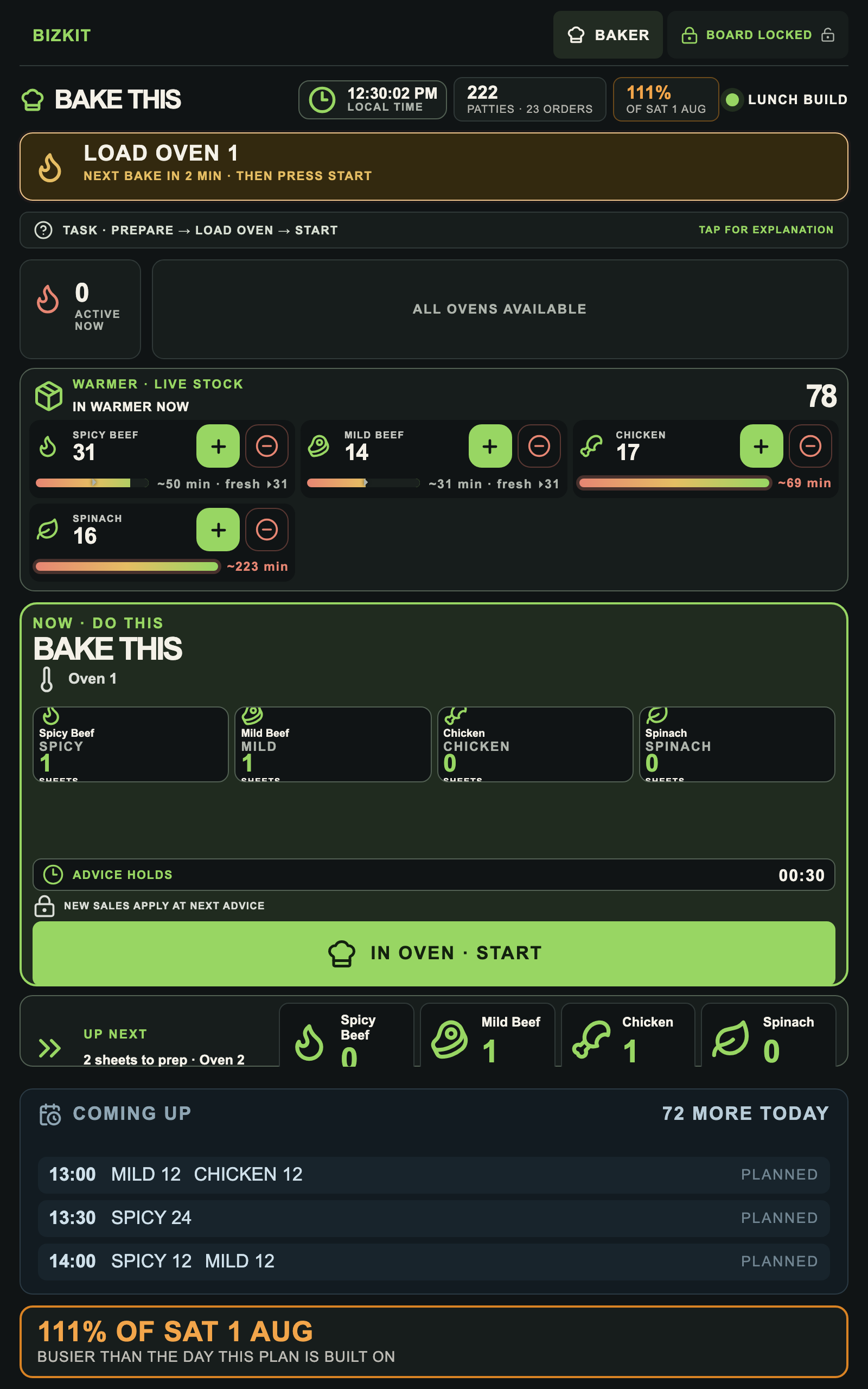
Bake This watches your sales as they happen and tells whoever is at the oven what to bake and when — sheet by sheet, in your own products, ovens and hours — on a wall tablet read in one glance from across the kitchen.
Running today as a live pilot in a working patty shop in Atlanta, refined against every trading day.
Marlin Bay demo shop · tap to enlarge
What it optimizes for
Three rules, in the order your shop already runs on
Every bakery balances the same three things. Bake This applies them in a fixed order, so when they pull against each other, the trade-off resolves the way you would resolve it.
Never run out
A customer who walks out empty-handed is the most expensive outcome there is. A stockout is worse than any leftover, for every product, at every hour — the slow movers included.
Almost nothing left at close
Production tapers toward closing so the case runs down with the day. You set the leftover you will accept — in Atlanta, twenty pieces or fewer across the whole case.
As fresh as possible
Every batch in the warmer carries its age. You set a freshness target in minutes, and the planner prefers many right-sized bakes over one big one that sits.
Rule one outranks rule two, rule two outranks rule three — always. The order came from a shop owner, not a spreadsheet.
New on the shop wall
The newest board faces the customer
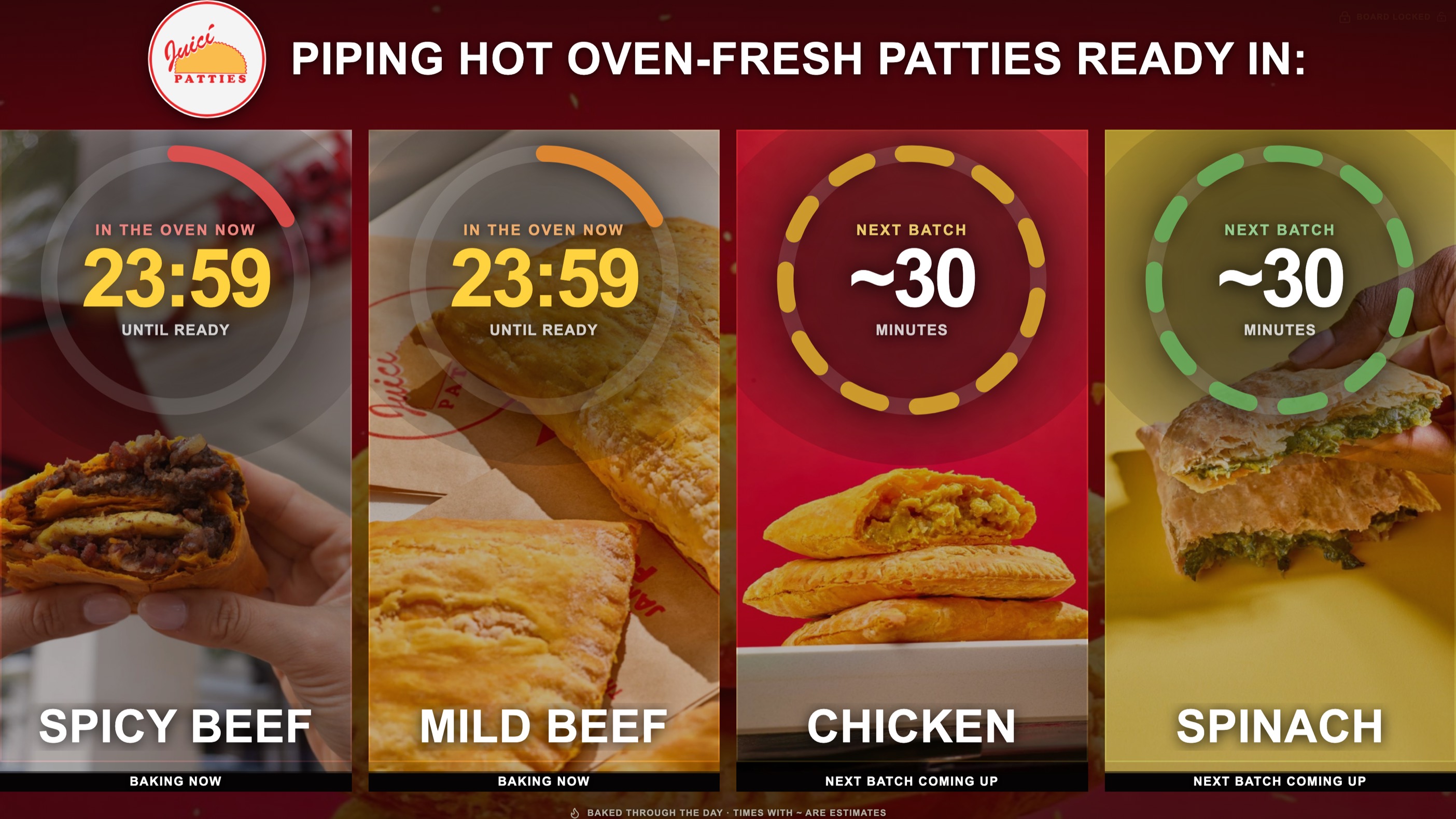
It hangs where the line can read it and says one thing per flavor: how long until the next batch comes out of the oven — a time, never a count.
Atlanta pilot · tap to enlarge
The line
The silent question — is it worth staying? — is answered from the wall before anyone peers into the case and guesses.
The counter
"When is the next one out?" now hangs behind the shoulder of the person asking it, so nobody promises a time they cannot know.
The oven
The countdown ticks only while a batch is actually in a running oven, so the promise on the wall is one only the baker can keep.
A day with it
What actually changes, from open to close
Before opening
The doors open on a full case
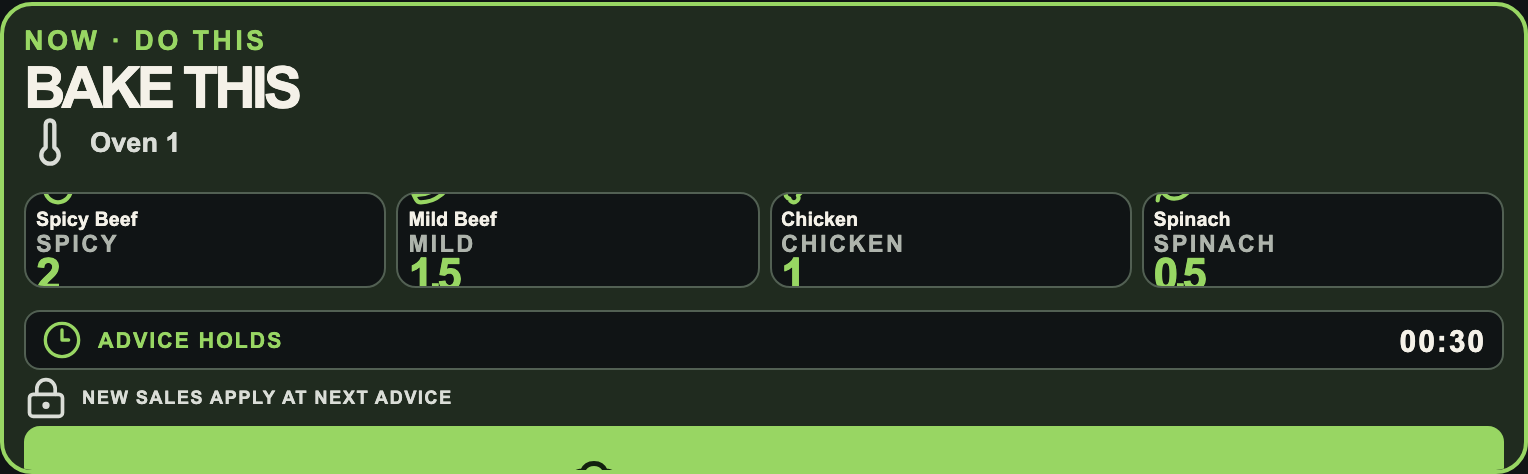
The pre-open bake is yours to define, product by product, down to a half sheet — and the board shows it before the day's first customer. The person opening doesn't have to remember; the wall does.
Marlin Bay demo shop · tap to enlarge
The lunch rush
Every bake is sized for the demand it will serve
A sheet that goes in at 12:05 sells from 12:25, so every bake is sized for the moment the tray comes out of the oven. The board also shows today trading against the day the plan was built from, so a hot day is visible while it is happening, not in tomorrow's report.



Marlin Bay demo shop · tap a shot to enlarge
Mid-afternoon, running behind
One glance says what to bake now
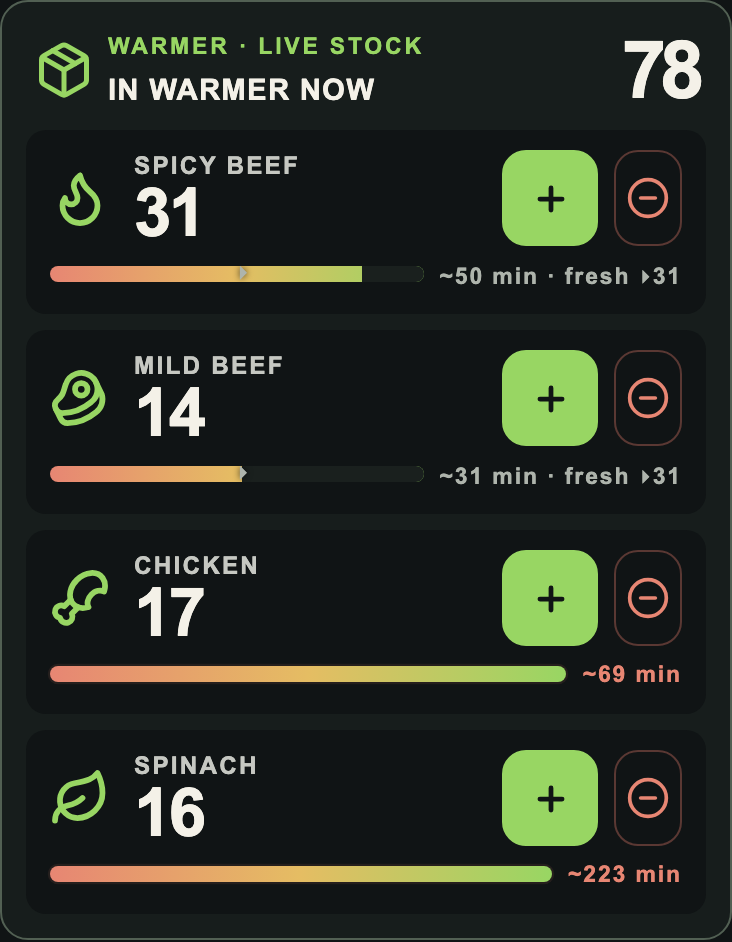
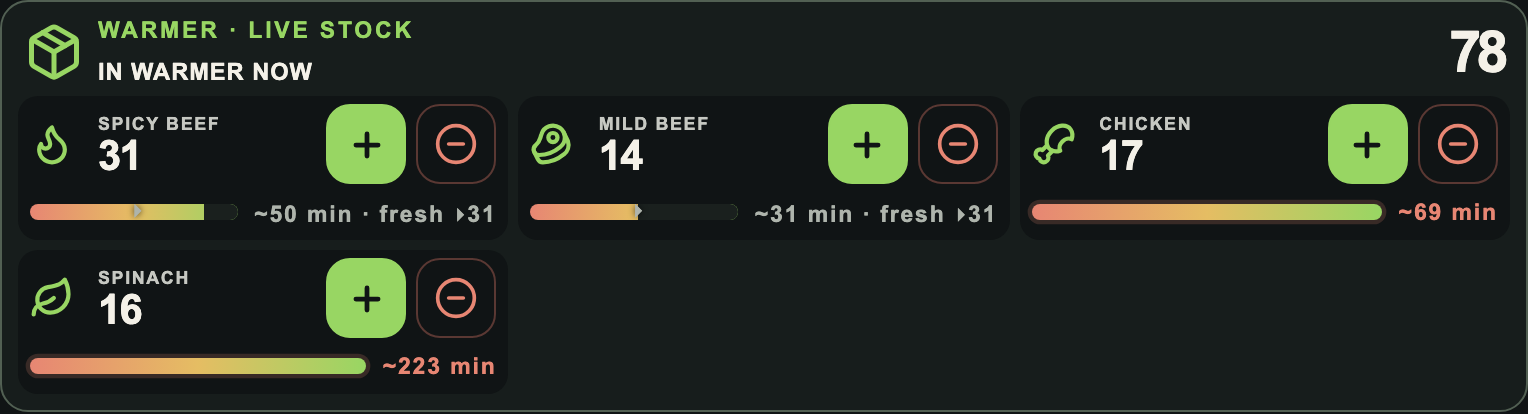
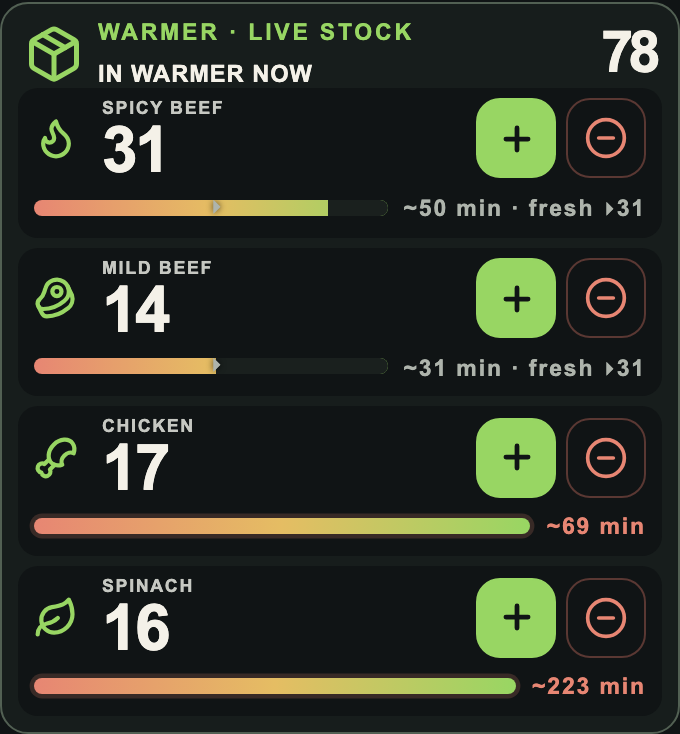
When the kitchen gets loud, the board stays simple: the next bake, its sheets per product, when to start it — and if it should have started already, it says so. Every Toast sale is deducted as it rings up, so the stock on the screen moves with the line at the register, and every request you couldn't serve is counted, not shrugged off. Disagree with the plan? Override it in a tap, and the board follows you.
Marlin Bay demo shop · tap a shot to enlarge
The last hour
The wind-down to an almost-empty case
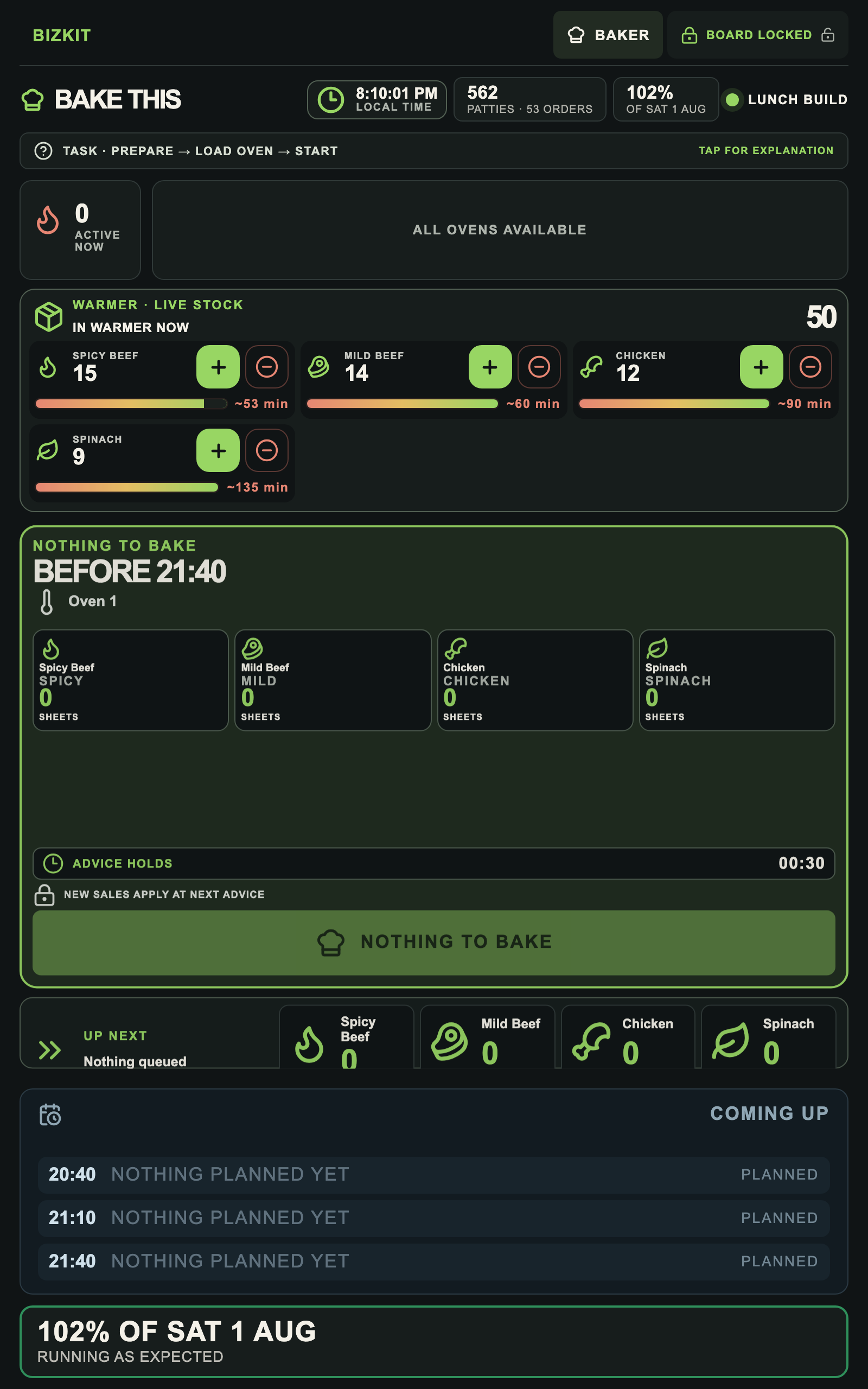
From a set time before closing, every advised bake shrinks toward zero, and the board will never advise a bake that comes out of the oven after the doors are locked. What is left at close is what you chose to accept — not what happened to survive.
Marlin Bay demo shop · tap to enlarge
How it decides
No black box. Every number has a reason you can say out loud.
We could call it AI; we'd rather say what it does. The plan is never finished — the board asks for a fresh picture every second, the register is heard every thirty seconds — and everything it weighs is something in your shop you can point at.
More at once than a person can hold
- This weekday, last time it was normal
- The days that were not normal — left out
- The shape of the day, hour by hour
- Each flavor's share of each hour
- What the register just rang up
- What is already in the ovens
- Your sheets, your ovens, your bake times
- How fresh is fresh enough
- What you accept left at close
→ one answer: the next bake — sheets per flavor, and when to start
Your history is the forecast
Any day plans from your shop's most recent normal weekday — a Tuesday from the last true Tuesday — hour by hour, flavor by flavor, straight off the register. Not-normal days teach it nothing; there is no industry average underneath.
Your judgment is the dial
You set one factor for today — rain coming, a game, a hunch — from the couch the night before. The day's weather hangs beside the dial; the judgment stays yours, and everyone on shift can hear why today runs at 80%.
Every number has a why
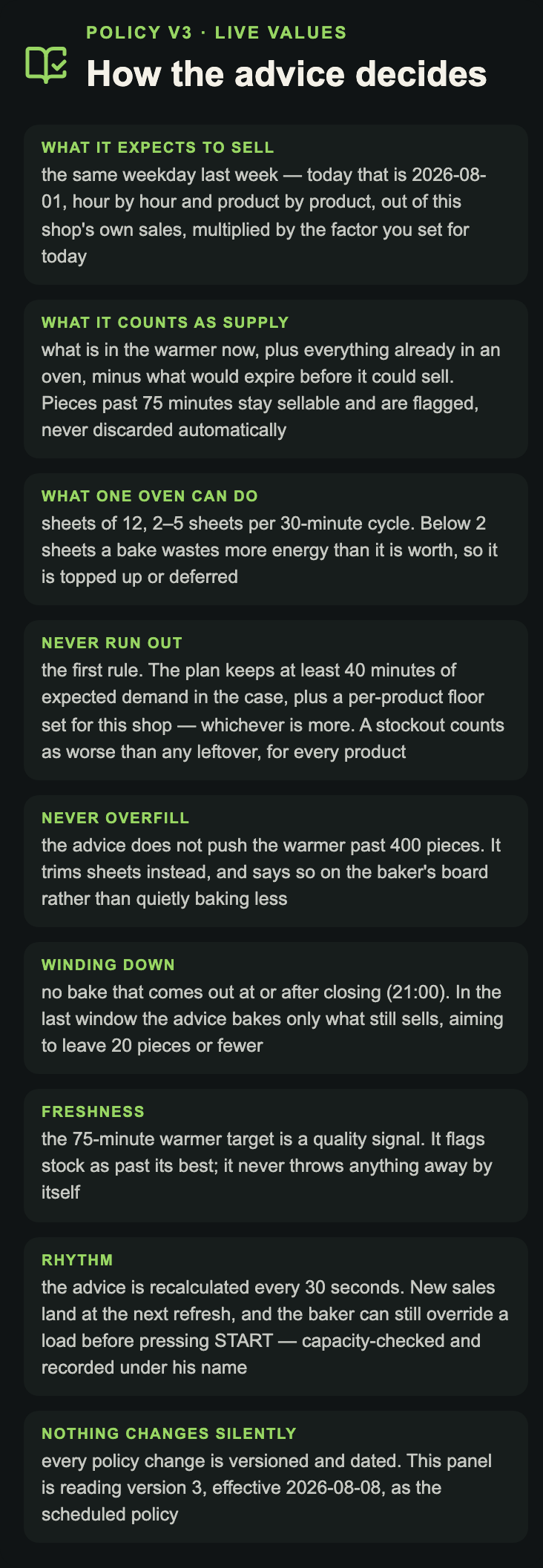
Ask "why five sheets?" and the answer is the source day, the warmer, the ovens and the buffer — in patties and minutes, never "trust the model".
Every dial is yours
Freshness target, buffers, the closing taper, the pre-open bake, per-product caps, opening hours — an owner changes them tonight, from a phone, without a developer. The baker's board needs no login at all.
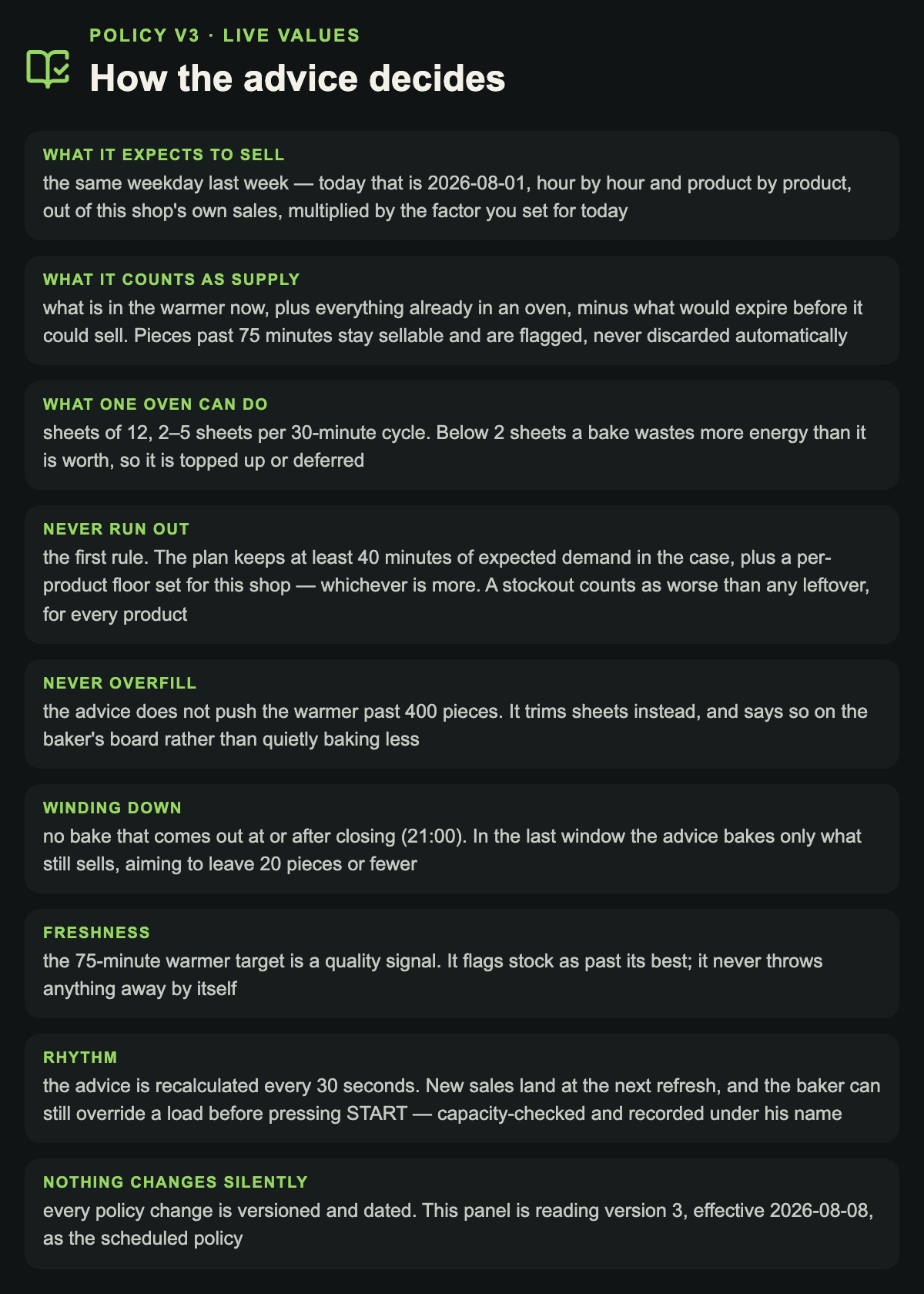
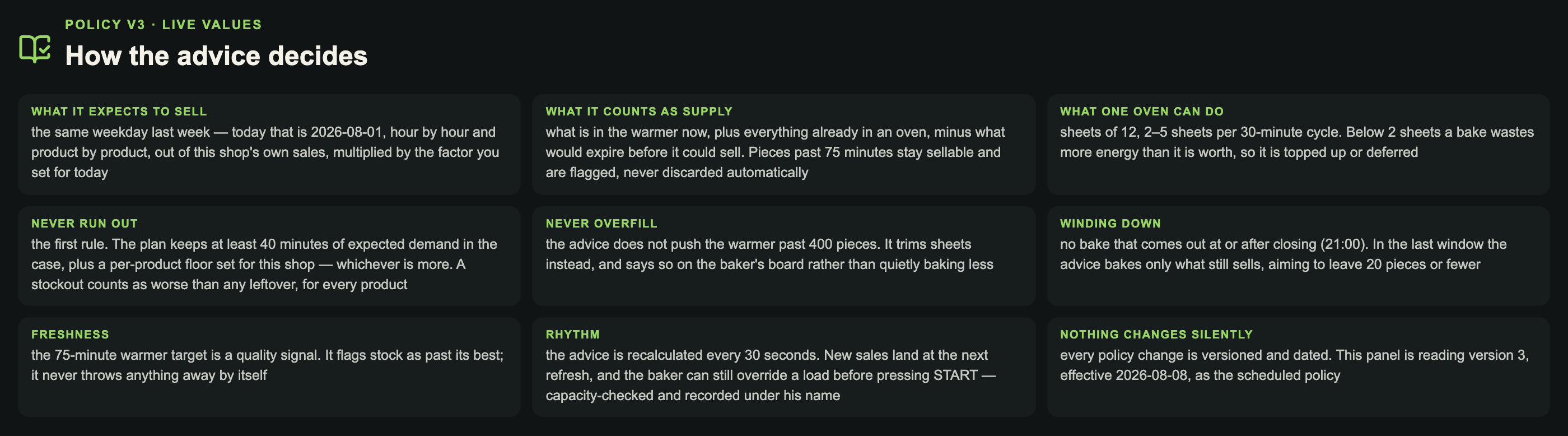
Marlin Bay demo shop · tap a shot to enlarge
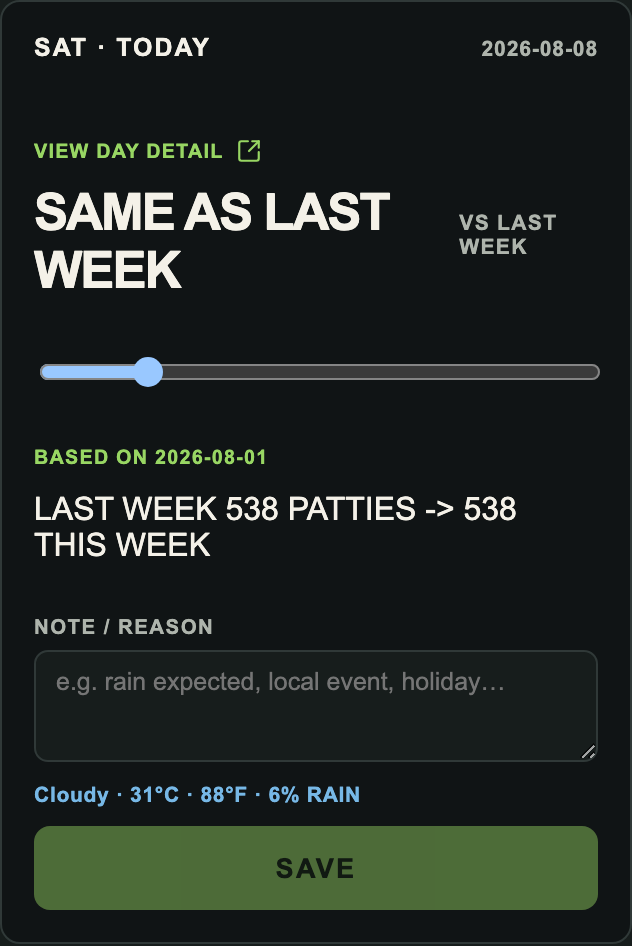
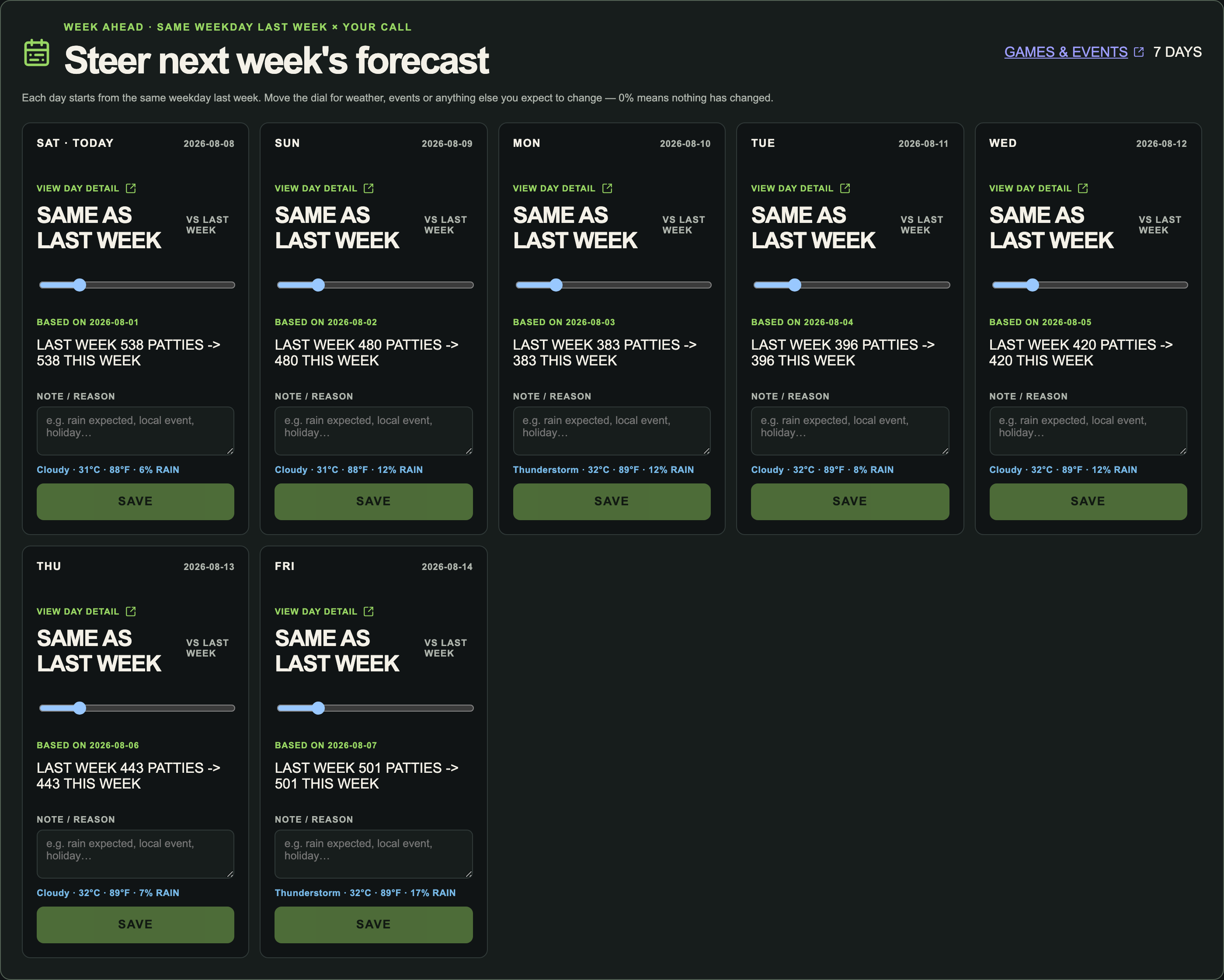
Marlin Bay demo shop · tap a shot to enlarge
The Atlanta pilot
One shop first, on purpose
Bake This is not a demo. It runs today as a live pilot in one patty shop in Atlanta, and that shop has shaped every screen on this page. The patty is the pilot's product, not the planner's limit: a shop that bakes coco bread, croissants or pies sets its own products and ovens, and the board reads the same.
The algorithm started with more mathematics than it has today; a working kitchen sanded it down until what was left is the owner's own method made precise — his shop's normal weekdays as the base, his judgment as the dial. We do not print the pilot's numbers — they are his; the screenshots come from a demo shop built for the purpose.
The pilot measures what the owner cares about: what is left at close against his target of twenty pieces or fewer, whether any flavor ran out, and how old each patty was when it sold. Those numbers appear here once they are measured properly — not before.
Since 11 August the same plan also runs in a second kitchen, where the advice is followed exactly as it is given — so the difference between a plan and a decision can be counted rather than argued about: the Baker Challenge.
A busy Saturday forgives you. It is the slow Monday, the rainy afternoon, where habit bakes for the day you hoped for — and the bin gets the difference.
What it needs
What it runs on
- Your register
- Bake This reads live sales from Toast POS as they happen. If the feed goes quiet, the board says so instead of showing a stock count it cannot back. On a different system? Tell us in the form — it shapes what we build next.
- The boards
- Any tablet with a browser — the old one in the drawer will do. Plain web pages: no app store, no install, no new hardware. The baker's board is a kiosk with no login; the counter crew's read-only board talks in units, not dollars — money stays behind the owner's login.
- A phone for the owner
- Settings, the day factor and the evening's numbers work from your pocket.
- Locations
- Multi-tenant from day one — each shop gets its own products, ovens, opening hours and settings.
- The customer board
- One time per flavor, never a quantity — there is no field to print a count from. The countdown runs only while that flavor is in a running oven, driven off the oven's own timer; otherwise the card says the next batch is one bake away, marked as an estimate on the board's own face. Skin, logo, photographs and each flavor's line are the shop's settings — a franchisee's board carries their brand.
- Honest when blind
- If the live feed drops, the board says it is not live rather than counting down on stale numbers; outside opening hours it says closed, with today's hours.
Talk to us
See it on your own numbers
A walkthrough is thirty minutes: your products, your hours, your ovens, and what the board would have said last Tuesday. No slide deck.
Franchise operator? Mention how many locations — the multi-location setup is a conversation of its own.
Want the shape of it first? What it takes to get you running — what you bring, what we do, and in what order.
Privacy
What this page does with your details
This page sets no cookies, stores nothing in your browser, loads nothing from anywhere else and carries no analytics or tracking of any kind. The form above does not send anything by itself: it opens your own mail app with your answers filled in, and nothing leaves your machine until you press send.
If you do write to us, we keep your mail in order to reply to it and for nothing else. You are not added to a list, your details go to no one outside Bizkit, and you can ask us to delete them at any time — nathan@bake-this.com.
The web server that hands you this page keeps an ordinary access log — the request, the address it came from, the time — for security and for finding faults. It rolls over and old entries are discarded.